Spirit Airlines
Making budget travel feel like a choice, not a compromise
Role
Brand Designer
Product Designer

Outcomes.

What it delivers.
A transparent add-on system that replaces surprise fees with upfront choice. An in-airport vending machine that turns a missed comfort item into a 30 second purchase at the gate. An app that rewards eco-conscious travel with loyalty points, addressing the 90 percent of travelers who said incentives would change their behavior.
The problem: low prices were costing Spirit its customers.

The fare is honest. The total is a surprise.
Spirit competes on being the cheapest option, and it wins that fight. But passengers arrive happy about the fare and leave feeling tricked. Our research surfaced the same three frustrations again and again.
Fees that appear late: 80% of the travelers we surveyed described Spirit's fees as hidden or unclear.
Comfort with no options: Passengers could not plan for their own comfort, only react to its absence.
Add-ons too complex to bother with: The booking flow buried the very upsells the business depends on.
The strategic problem underneath.
Spirit's revenue model relies on add-on purchases, but its add-on experience makes customers resent buying them. Fixing transparency was never a concession on revenue. It was the path to more of it.
The question: How does Spirit keep its cost advantage while making passengers feel they chose their experience rather than had it taken from them?
Understanding budget travelers' needs.
What 100+ travelers actually told us.
We ran an in-depth UX research process built to reach people who fly budget by necessity, not preference.
User interviews with frequent budget travelers.
Surveys of 100+ airline passengers.
Cultural probes analyzing real behavior in airport settings. Competitive analysis of ULCCs including Frontier and Ryanair.

The decisions that shaped the product.

Bundle the add-ons, or sell them individually?
The tension: Individual items give travelers maximum control. Bundles are faster to understand and easier to sell.
What research said: Passengers were not overwhelmed by price, they were overwhelmed by decisions late in a booking flow.
What shipped: Curated packages with clear names, plus the ability to build a custom bundle. Speed by default, control on request.
What we gave up: Some pricing granularity, in exchange for a decision a tired traveler can make in seconds.
Solve the forgotten neck pillow in the app, or at the gate?
The tension: Everything is cheaper to build in the app. But the need appears at the gate, minutes before boarding, when nobody wants to download anything.
What research said: Cultural probes showed the comfort gap being felt physically in the terminal, not remembered during booking.
What shipped: Physical vending machines at gates and check-in. No app required, instant payment.
Why it matters commercially: It converts a frustration into a sale at the exact moment of highest intent.
Make sustainability a value, or a reward?
The tension: The team wanted sustainability to be principled. The research said principle alone would not change behavior.
What shipped: Eco choices earn loyalty points. Digital boarding passes, packing light, sustainable partner deals.
The honest tradeoff: A less idealistic version of the idea, and the version 90% of travelers said they would actually use.
Refining our designs.
Three rounds, and what each one changed.
Round 1: Low-fi wireframes → Users wanted larger touch points. We enlarged every interactive element throughout.
Round 2: Mid-fi prototypes → Deals were being missed. We repositioned deal placement and sharpened sustainability messaging.
Round 3: Hi-fi testing → 100% of users preferred our app to the existing Spirit interface, with a 100% task success rate.

The Spirit Airlines Redesign: Key Features & Innovations.
Location: Gates & Check-In Areas.
Imagine arriving at your gate and realizing you forgot your neck pillow or need Wi-Fi for an urgent work email. With Spirit’s new pre-flight vending machines, passengers can:
Browse curated travel packages (e.g., comfort kits, noise-canceling headphones).
Build their own bundle based on what they need.
Pay instantly at the gate—no app required.
Add-On Packages: Customizing Comfort, Without the Hidden Fees.
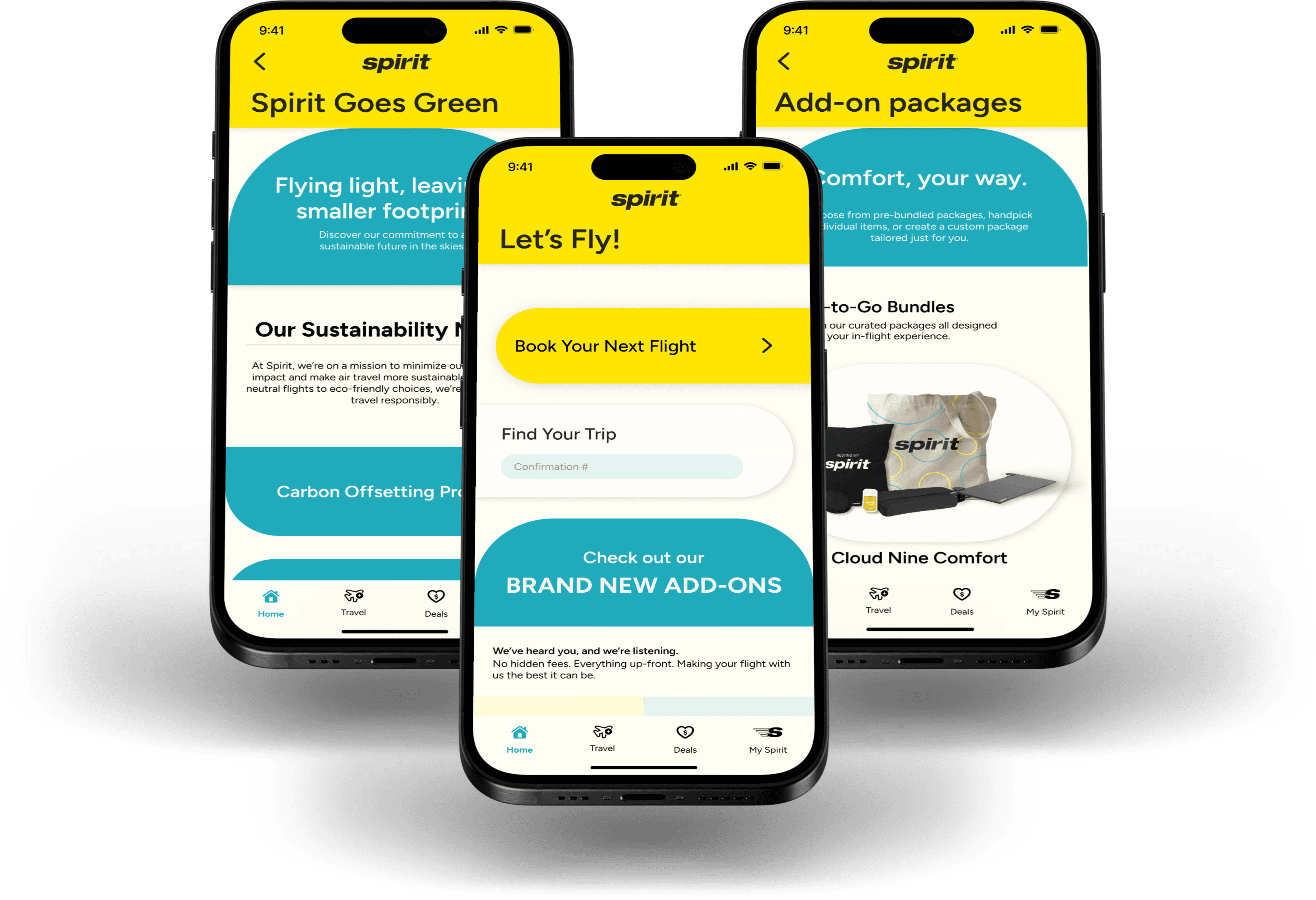
Budget travelers want choices - but without the stress of last-minute surprise fees. We introduced a new add-on system that allows passengers to pre-purchase exactly what they want for a smoother, more comfortable flight.
Standard Add-On Packages:
Cloud Nine Comfort – Neck pillows, blankets, extra legroom.
Focus In-Flight – Noise-canceling headphones, Wi-Fi access.
Family Flight – Kid-friendly kits with snacks and entertainment.
Special Event Packages:
Spirit x Coachella – Festival-ready kits.
Spirit x NFL – Sports travel essentials.
Spirit x Mardi Gras – Beads, masks, and celebratory gear.
Spirit Airlines App Redesign: More Transparency, Less Confusion.
Spirit’s current app was confusing and lacked clarity when it came to add-ons, loyalty points, and sustainability efforts. We redesigned the app to make it intuitive, rewarding, and user-friendly.
New Features Include:
Transparent Add-On Pricing - No more surprise fees.
Sustainable Spirit Program - Earn loyalty points for making eco-friendly choices (e.g., choosing digital boarding passes, packing light, etc.).
Personalized Deals & Rewards - Offers based on travel history & loyalty status.
Real-Time Booking & Trip Management - A seamless, intuitive flight booking process