Medisafe
Helping seniors catch the fraud aimed at them
Role
UX Researcher
Product Designer

Fifty seniors, and one finding that reframed the brief.

Nobody would let fraud slide. They just could not see it, or reach it.
68% of seniors struggled to recognize fraud at all. 51.4% would first review their Medicare Summary Notice before reporting. 0% would ignore a suspicious charge, but most did not know where to report it.
Why that last number changed everything.
We expected apathy and found the opposite. Every senior we surveyed wanted to act. The failure sits upstream, in recognizing fraud, and downstream, in knowing where to take it.
So MediSafe was built to do two jobs rather than one: make fraud legible on a document seniors already reach for, and give them somewhere to take it. Every decision in this case study traces back to that sentence.
The problem: medicare fraud is an invisible epidemic.

The safeguard already exists, and nobody can read it.
Medicare fraud runs on three patterns, and every one of them appears on a statement mailed directly to the patient. The person best placed to catch it is already holding the evidence.
Double billing: The same service charged twice.
Upcoding: A routine visit billed as something more expensive.
Phantom charges: Care that never happened at all.
Key challenges seniors face.
Lack of awareness: Many seniors don't recognize fraudulent activity.
Complicated medicare billing: Difficult to verify services and identify overcharges.
Limited reporting mechanisms: Seniors feel overwhelmed by where and how to report fraud.
Technology barriers: Many struggle with digital platforms due to poor accessibility.
The question: How do you turn a document nobody reads into something a person can act on?
Understanding user pain points.
50 participants, 100+ insights.
Three methods, chosen to reach people who are rarely included in product research and are the most targeted by fraud.
Interviews: In-depth conversations revealed personal struggles and preferences.
Surveys: Quantitative data highlighted common challenges and needs.
Cultural probes: Daily interactions showed how seniors actually engage with technology and Medicare, rather than how they describe it.
Three findings, and what each one decided.
Comprehension is the security layer. 68% could not recognize fraud while looking straight at it.
Decided: the interface translates billing into events a person recognizes from their own life. Plain language stopped being polish and became the detection mechanism.
The Medicare Summary Notice is the natural anchor. 51.4% already reach for the MSN first.
Decided: we met people at the document they already trust, instead of asking them to learn a new mental model.
The gap is the path, not the willingness. 0% would ignore a suspicious charge, yet most had no idea where to report it.
Decided: the reporting portal exists because of this finding. Detection without a route to act on it is a dead end.
The decisions that shaped MediSafe.

Teach a new system, or use the one they already have?
The tension: A purpose-built billing view would be cleaner. But it asks seniors to learn something new at exactly the moment they feel least confident.
What research said: 51.4% already reach for their Medicare Summary Notice first.
What shipped: Everything anchors to the MSN, the document they already trust.
Detection only, or a route to act?
The tension: Flagging suspicious charges is the easier product. Building a reporting path means committing to what happens next.
What research said: 0% would ignore a suspicious charge, but most did not know where to report it.
What shipped: Every alert is paired with a guided reporting path, plus live chat and phone support with Medicare fraud prevention agents.
Caregiver access, or senior autonomy?
The tension: Caregivers asked for oversight. Seniors are managing their own affairs and intend to keep it that way.
What shipped: Monitoring by permission, granted by the senior. Caregivers get visibility without taking independence away.
Designing for people the internet usually forgets.
Key design principles only, or a route to act?
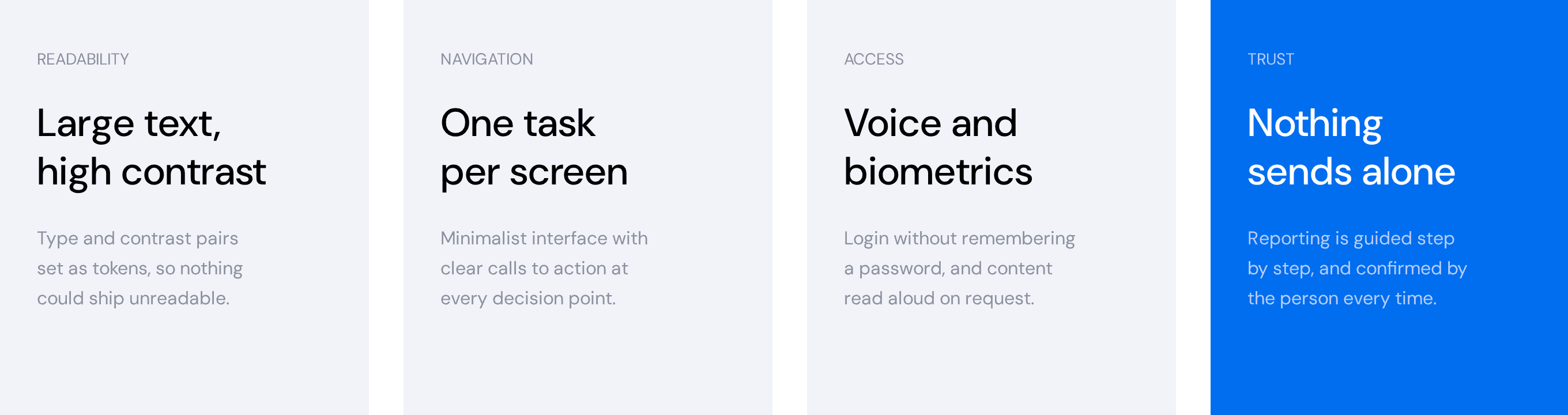
Simplicity: Interfaces tailored to seniors' preferences.
Security: Robust measures to protect users from fraud.
Empowerment: Tools that let seniors verify services and report discrepancies with confidence.
Refining the experience with seniors.

Three rounds, and what each one changed.
Round 1: Low-fi wireframes → Basic flows designed for accessibility first.
Round 2: Mid-fi testing → Interface adjusted directly on senior feedback.
Round 3: Hi-fi prototype → Integrated voice assistance, larger buttons, and simplified navigation.
What testing changed.
Step-by-step guidance: Seniors wanted to be walked through verifying a charge, not handed a verdict.
A caregiver dashboard: Requested as one overview for billing and fraud alerts.
Bigger, clearer controls: Buttons and progress bars needed far more visibility than we first gave them.
Final adjustments: Enlarged key interface elements, added the fraud alert system, and simplified account creation.
A secure path forward.
Transforming healthcare experiences for seniors.
Medisafe isn’t just a platform - it’s a commitment to restoring trust and dignity in healthcare for seniors. By providing a secure, two-way channel between seniors and healthcare providers, it empowers them to take charge of their Medicare benefits, protect against fraud, and reclaim peace of mind.
My Medicare dashboard.
View & Verify Bills: Easily compare billed services to actual care received.
Caregiver Monitoring: Allows authorized caregivers to oversee Medicare transactions.
Instant Alerts: Detects double billing, upcoding, and phantom charges.
Reporting portal.
Step-by-Step Guidance: Helps users report fraud quickly and track case progress.
Live Chat & Phone Support: Connects users with Medicare fraud prevention agents.
Fraud Alert System: Sends real-time scam warnings to users.
Medicare learning centre.
Daily Fraud Prevention Tips: Short, digestible insights on Medicare fraud.
AI Voice Assistant: Reads important Medicare information aloud.
Interactive Tutorials: Walks users through common fraud scenarios


Designing for trust & accessibility.
Key takeaways.
Seniors prioritize trust & security: Clear, human-centered design is crucial.
Caregiver involvement is essential: A shared dashboard improves Medicare management.
Fraud education must be simple & digestible: Short, engaging lessons work best.